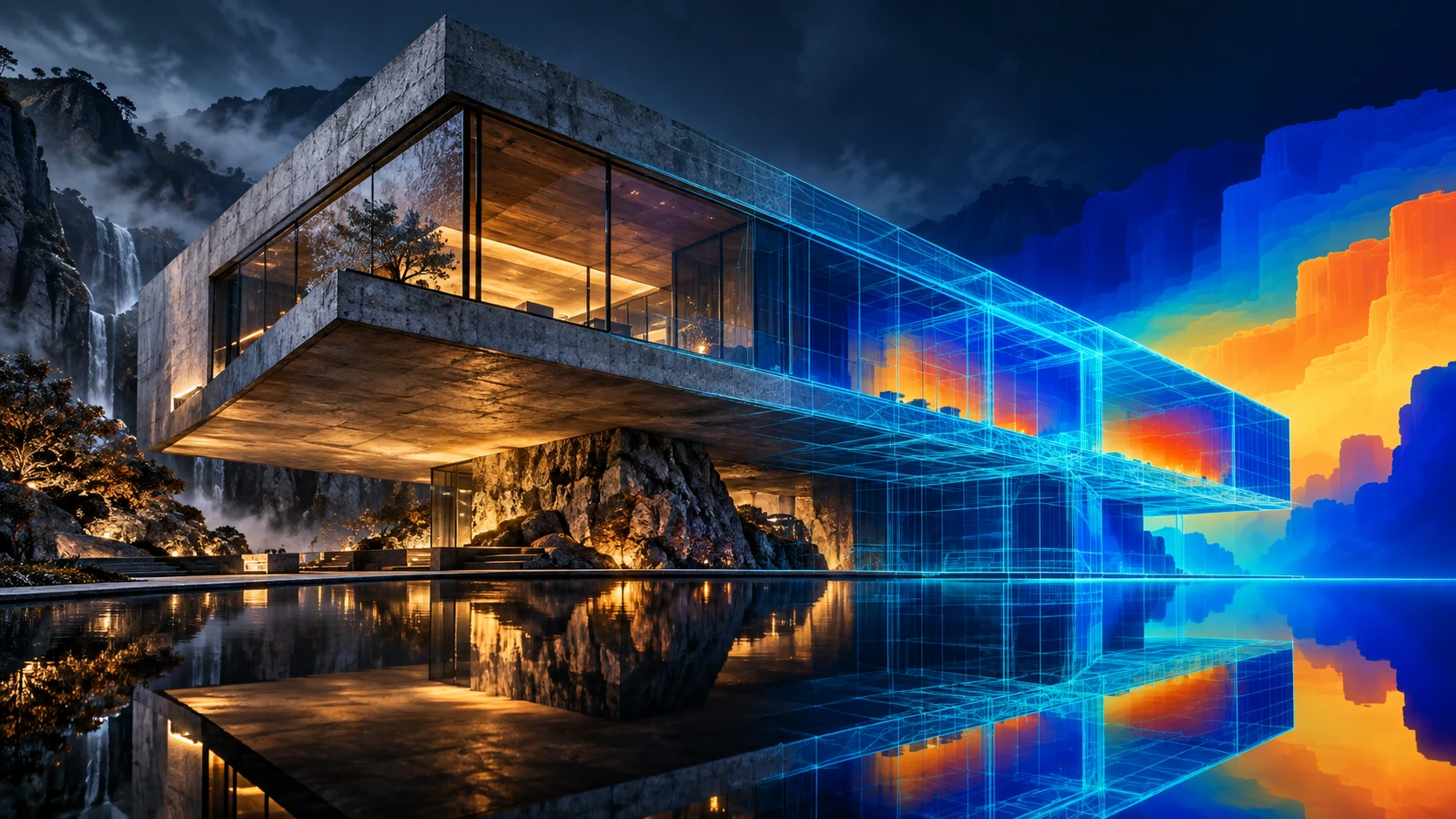
A client sends one flattened JPEG. The Revit file is unavailable, the renderer has discarded its passes, and the next review needs a changed material direction by noon. A depth preprocessor can turn that image into a control map in seconds. It can also decide that dark glazing is a deep hole, a pale wall is close, and every chair leg belongs to the floor.
That distinction matters in ComfyUI. A model such as Depth Anything V3 infers relative scene structure from pixels. It does not recover wall thickness, object identity, dimensions, or the original camera. The output can guide a generative pass, but it is still an estimate. An architecture workflow needs an acceptance test between preprocessing and sampling.
Recent community guidance points designers without original depth or Canny passes toward inferred controls. The advice is useful, especially for rescuing old renders and third-party images. The missing step is deciding when the inferred map is good enough, when it needs repair, and when the team should return to the model.
Start with the strongest source you actually have
Rank the available evidence before running any preprocessor. An exported depth pass from the source model is better than inferred depth because it comes from the scene geometry. A clay viewport with clear edges is usually easier to infer than a finished dusk render. A high-resolution daytime image is usually easier than a compressed social post full of bloom, fog, reflections, and motion blur.
Do not enlarge a tiny source and mistake more pixels for more evidence. Upscaling may make edges easier to inspect, but it cannot restore occluded geometry. Keep the untouched source beside every derived map. Record the preprocessor, model version, input dimensions, crop, and any normalization setting so another designer can reproduce the result.
Check one: the silhouette must remain continuous
Inspect the roofline, projecting balconies, canopies, corners, and contact with the ground. These are the largest structural cues in the frame. The depth map should show coherent changes across major planes, without halos that detach the building from the sky or smear a canopy into the facade.
A narrow halo may look harmless in grayscale but becomes an instruction during sampling. It can produce swollen parapets, doubled roof edges, or a strip of invented material around the building. Crop tightly enough to inspect the boundary at 200 percent. If the silhouette breaks in several important places, reject the map or repair it before testing a generation.
Check two: openings must read as surfaces, not tunnels
Windows are a common failure point because their pixels contain reflections, interior darkness, curtains, sky, and exterior structure at once. An inferred map may push dark glazing behind the facade or pull a bright reflection forward. Either error can change window depth, mullion position, and the apparent thickness of the wall.
Compare repeated bays. Similar windows on the same plane should have similar depth behavior unless the design says otherwise. Flag any opening that changes depth because its blind is closed, its reflection is bright, or a tree crosses it. For facade work, a manually simplified opening mask or edge control may be safer than asking depth alone to carry the rhythm.
Check three: thin elements need their own decision
Railings, mullions, cables, fins, furniture legs, and branches occupy too few pixels to generate stable depth. A preprocessor may erase them, merge them with the background, or give alternating members unrelated values. Increasing control strength cannot restore information that the map did not capture.
Decide which thin elements are design-critical. If a guardrail must survive, pair the depth map with a clean edge pass, a local mask, or a later compositing step. If temporary tree branches disappear, that may be acceptable. Write the decision before sampling so a visually pleasing image does not quietly lower the standard.
Check four: transparency and reflections need skepticism
Glass is not one depth plane. The camera sees the pane, reflections on its surface, frames, objects behind it, and sometimes another exterior beyond. A monocular estimator has to choose a visual interpretation. That interpretation can be plausible and still be wrong for the intended edit.
If the assignment changes only sky or planting, mask the glazing out of the controlled pass when possible. If the assignment changes the interior behind glass, use the map as a loose spatial hint and inspect every boundary. Do not use inferred depth as proof that an atrium, storefront, or curtain wall has been preserved.
Check five: ground and site planes must agree
Architecture meets the site at the most visible seam in the image. Check steps, curbs, ramps, retaining walls, paving joints, and the base of planted objects. The map should show a credible progression away from the camera. Sudden bands caused by shadows or material colors can bend a flat plaza into terraces during generation.
Draw three or four sample lines from foreground to background and watch the grayscale transition. A sharp change should correspond to a real edge or level change. When it does not, repair the map or reduce its influence in that zone. A shadow line is lighting evidence, not geometry evidence.
| Map condition | Decision | Next action |
|---|---|---|
| Major planes and openings are coherent | Accept for controlled test | Run low-cost samples at modest strength |
| Local errors affect noncritical content | Accept with exclusions | Mask, crop, or repair named regions |
| Repeated bays or silhouette disagree | Reject | Use source geometry or another control |
| Glass dominates the assignment | Use as weak secondary evidence | Inspect every transparent boundary |
| Thin structure carries the design | Depth alone is insufficient | Add edge evidence or composite later |
Run a diagnostic pass before a beauty pass
Load the source, generate the depth map, and save it as a named intermediate file. Then run a small batch with a plain instruction and restrained denoise or control settings. Avoid dramatic weather, complex planting, crowds, and stylized light. The goal is to expose structural behavior, not produce a portfolio frame.
Place the source, map, and outputs in one contact sheet. Mark silhouette changes, opening errors, lost thin elements, glass changes, and broken ground contact. Keep the seed fixed while testing control strength. Then keep the accepted strength fixed while testing the actual appearance instruction. Changing both at once hides the cause of failure.
Set a stop rule. For example, reject a route if it changes the opening count, moves the roof edge, breaks a required railing, or creates a false level change after two controlled attempts. A stop rule prevents ten attractive failures from turning into an afternoon of rationalization.
Our take: inferred depth is a rescue pass
Depth Anything V3 is valuable because many real projects arrive without clean render passes. It can recover enough relative structure to support material studies, atmospheric changes, selective enhancement, and early option work. Its usefulness grows when the team treats the result as visible evidence that can be inspected and edited.
It should not replace a depth export when the model is available. It should not carry detailed facade accountability by itself. It should never inherit authority merely because the grayscale image looks smooth.
Save the map. Mark the lies. Then decide whether it gets a wire.
Based on the 11 September 2026 intel sweep, including community discussion of Depth Anything V3 as a preprocessor when original architectural depth and Canny passes are unavailable. Model availability, node support, and output behavior can change; verify the installed workflow before project use.