
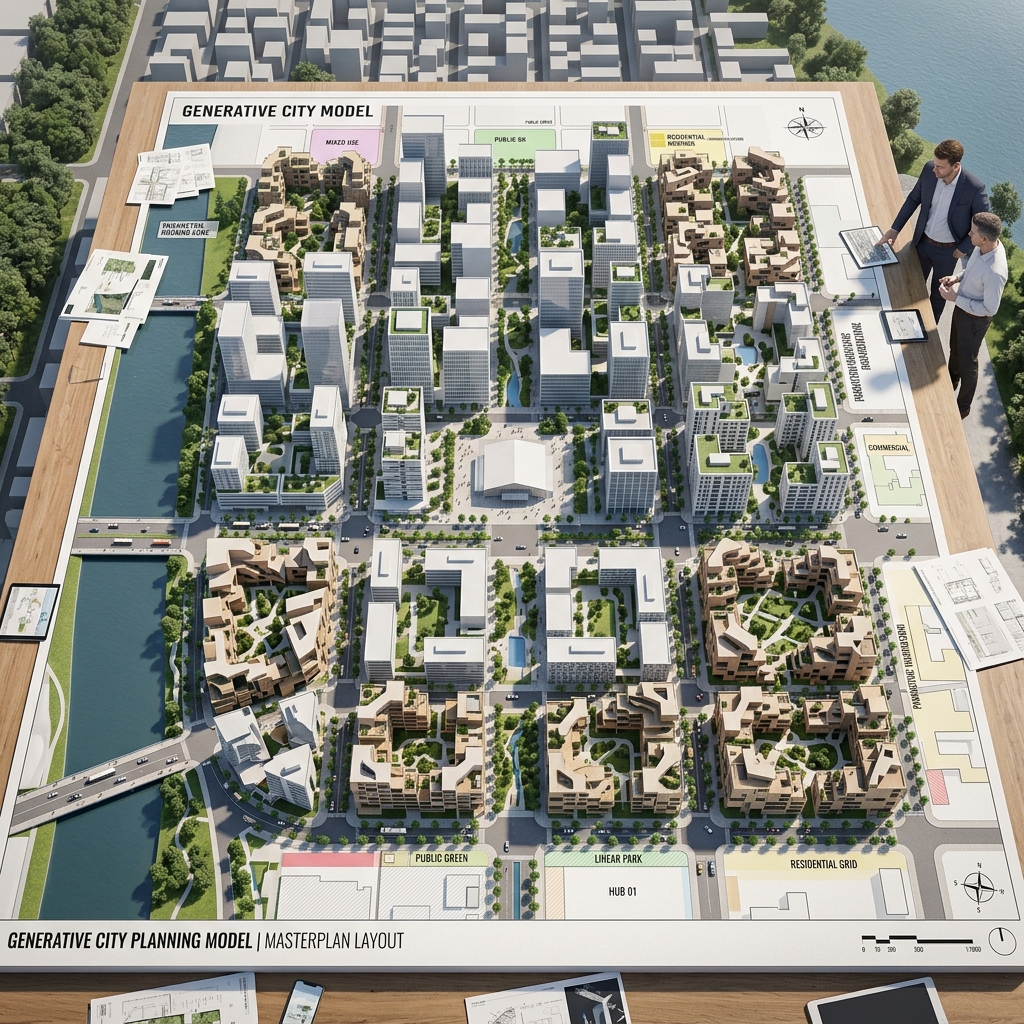
The 2026 "Top AI tools for architects" lists keep grouping three names together: Finch 3D, Veras, and TestFit. The grouping is misleading, each one solves a different problem, but TestFit is the one that's quietly become non-optional. Developer clients now expect it. Civic-side reviewers know what it is. And in the last twelve months, TestFit has gone from "a feasibility tool we tolerate" to "the place pre-design actually happens."
Here's what TestFit actually does on that kind of project, what it gets wrong, and where it fits in the 2026 pre-design stack.
Generative feasibility software for site planning and pro-forma testing. Strongest on parking-driven multifamily, podium mixed-use, and senior living. Adds new modules for industrial and BTR. Real-time pro-forma feedback as you adjust massing, setbacks, and unit mix. Not a design tool, a feasibility engine that reduces the cost of testing a parti.
What TestFit actually is
TestFit is not generative design in the Finch 3D sense, it doesn't propose a design from a brief and let the algorithm find a Pareto frontier. It's closer to a constrained massing solver bolted to a real-time pro-forma. You define the site, the program, and the rules (zoning setbacks, FAR, parking ratios, unit mix targets), and TestFit produces a building configuration that satisfies the constraints and reports the financial implications instantly.
The "AI" framing in the marketing is generous. The underlying solver is closer to mature constraint programming than to learned generative models. That's actually what makes it useful: the outputs are deterministic and explainable. When the developer asks why the unit count dropped from 84 to 79, you can point to the setback change and the parking ratio rather than shrugging at a black box.
What's changed in the last year is the speed of iteration and the depth of pro-forma integration. The solver now feels real-time on most sites under three acres. The pro-forma module is no longer just unit count and gross area, it tracks per-unit construction cost, parking cost separately, common area factor, and lets you sensitize against rent assumptions on the fly.

Stage one, setting up the site
For our infill site, setup took roughly 25 minutes. Pull in the parcel from the integrated GIS layer (TestFit reads from public county data in most US jurisdictions), apply the zoning rules, define the program. The zoning import was about 80% accurate, it caught the base FAR and height limit but missed a transit-overlay bonus we had to add manually. Standard for any tool reading parcel data; nothing unusual.
The program setup is where TestFit's bias shows. Multifamily and podium mixed-use are first-class citizens. The constraints understand unit-mix percentages, double-loaded vs single-loaded corridor preferences, podium parking ratios per unit, and elevator-to-unit count rules. If your project doesn't fit one of those archetypes, and a surprising number don't, you're forcing the solver to do something it's not optimized for, and the outputs feel less confident.
For our project, TestFit's defaults were a reasonable starting point. We tweaked the unit-mix to 30% studio, 50% one-bed, 20% two-bed and the corridor preference to double-loaded. The solver produced a first massing in under 20 seconds.
The first ten minutes of TestFit replace what used to be three days of junior-level test fits. The next two hours replace another week of pro-forma cycling.
Stage two, iterating the parti
This is where TestFit earns its seat license. We had three setback variations the entitlement team wanted to compare: as-of-right, with a 5-foot setback waiver on the alley side, and with the transit-overlay bonus applied. Conventionally, that's three separate test fits, three pro-formas, and a side-by-side comparison memo, call it two days of work.
In TestFit, it took 40 minutes. Each setback change triggers a re-solve, the unit count and gross area update, and the pro-forma, using the rent and cost assumptions we'd already entered, recalculates immediately. Output: 84 units at $58M project cost, 91 units at $62M, 96 units at $64M. Not the final answer, but a usable comparison the developer could react to in real time on a video call.
That's the central use case. Developers want to know if a parti pencils now, not after a week of massing. TestFit collapses the loop from days to minutes. The parti they push forward to design is one they've already stress-tested against rent assumptions, parking ratios, and three different zoning interpretations.

Stage three, handing off to design
The export is fine, not great. TestFit exports to Revit, SketchUp, and Rhino with reasonable fidelity for the building footprint, podium massing, and parking layout. What doesn't survive cleanly is intent. The export is geometry, not a parametric structure that the design team can keep editing inside TestFit's logic. Once you've handed off, you've left the feasibility loop.
We'd love this to evolve. The dream is a TestFit-Revit live link where adjustments in either tool propagate back. Right now, you treat the TestFit export as a starting point that the design team will rebuild in their preferred tool. If the developer comes back with a setback change after design has started, you're either re-running the feasibility in TestFit and losing the design work, or making the change in Revit and losing the pro-forma feedback. Neither is good.
How it compares to the alternatives
| Approach | Time to first parti | Pro-forma integration | Best for |
|---|---|---|---|
| Manual SketchUp + Excel | 2–3 days | Disconnected, copy/paste | Edge-case program types |
| Finch 3D | 1–2 hours | Limited, geometry-first | Schematic exploration, not feasibility |
| TestFit | 20 minutes | Real-time, integrated | Multifamily, podium MU, BTR, industrial |
| Spacemaker / Autodesk Forma | 1 day | Site-level, less granular | Master-planning, sun/wind analysis |
The straightforward read: if you're doing multifamily or podium mixed-use feasibility regularly, TestFit replaces a meaningful chunk of pre-design labor and a meaningful chunk of pro-forma back-and-forth. If you're doing institutional, civic, or one-off custom work, it's not your tool.
Where it still falls short
Edge-case programs. Single-family, custom estate, civic, or anything with significant program complexity outside the supported archetypes, TestFit will produce something, but it won't feel confident. We'd reach for a different tool for those projects.
Design quality, not feasibility. TestFit's outputs are valid as feasibility studies. They are not designs. The aesthetic vocabulary is generic boxes with reasonable proportions. The job after TestFit is to take the program and footprint into a real design tool and make it not look like every other podium project.
The handoff to Revit. Already covered above, the export is one-way, and the lack of a live link is the largest single quality-of-life gap.
Pricing. The seat cost has crept up. For a sole practitioner doing one feasibility a quarter, it's hard to justify. For a developer-side team or a firm with steady deal-flow, it pays for itself on the first project.
Who this is for
If you do developer-side work, multifamily, podium mixed-use, BTR, senior living, industrial, TestFit is the default tool now. Not optional. The developer is going to expect feasibility-quality outputs at the speed TestFit produces them. Practices that don't have it are losing the early conversation to firms that do.
If you do design-side work and partner with developers, you should know TestFit well enough to read its outputs critically. The developer will hand you a TestFit massing as the starting point. Your job is to recognize when the assumptions are reasonable, when they're aggressive, and when the parti has been over-fit to the pro-forma at the cost of the building.
If you do institutional, civic, or custom design work, TestFit is irrelevant. Your feasibility looks different. Don't buy a seat to feel current.
What we'd ask TestFit for next
Three things, ranked.
First: a Revit live-link. The biggest unlock for the design-side relationship is being able to feed setback or program changes back into a feasibility model without losing the design work in flight.
Second: better support for adaptive reuse. TestFit assumes greenfield or near-greenfield. The growing market for adaptive reuse, converting class-B office, retail boxes, parking structures, needs feasibility tooling, and TestFit's current solver doesn't handle existing geometry as a constraint cleanly.
Third: a junior pricing tier. The current pricing makes sense for firms with regular dealflow. Solo practitioners and small studios are priced out of the upside.
If you're doing podium multifamily feasibility in 2026, TestFit isn't optional anymore. The developer expects it; the entitlement team uses the same outputs; the schedule compression is real. Buy the seat, learn the constraints, and get used to producing pre-design comparisons in 40 minutes that used to take a week.
If your work is outside the supported program archetypes, the seat is harder to justify. TestFit's solver is narrow on purpose, that's why it's fast, and that's why you shouldn't force it onto projects it doesn't understand.
No affiliate relationship with TestFit.