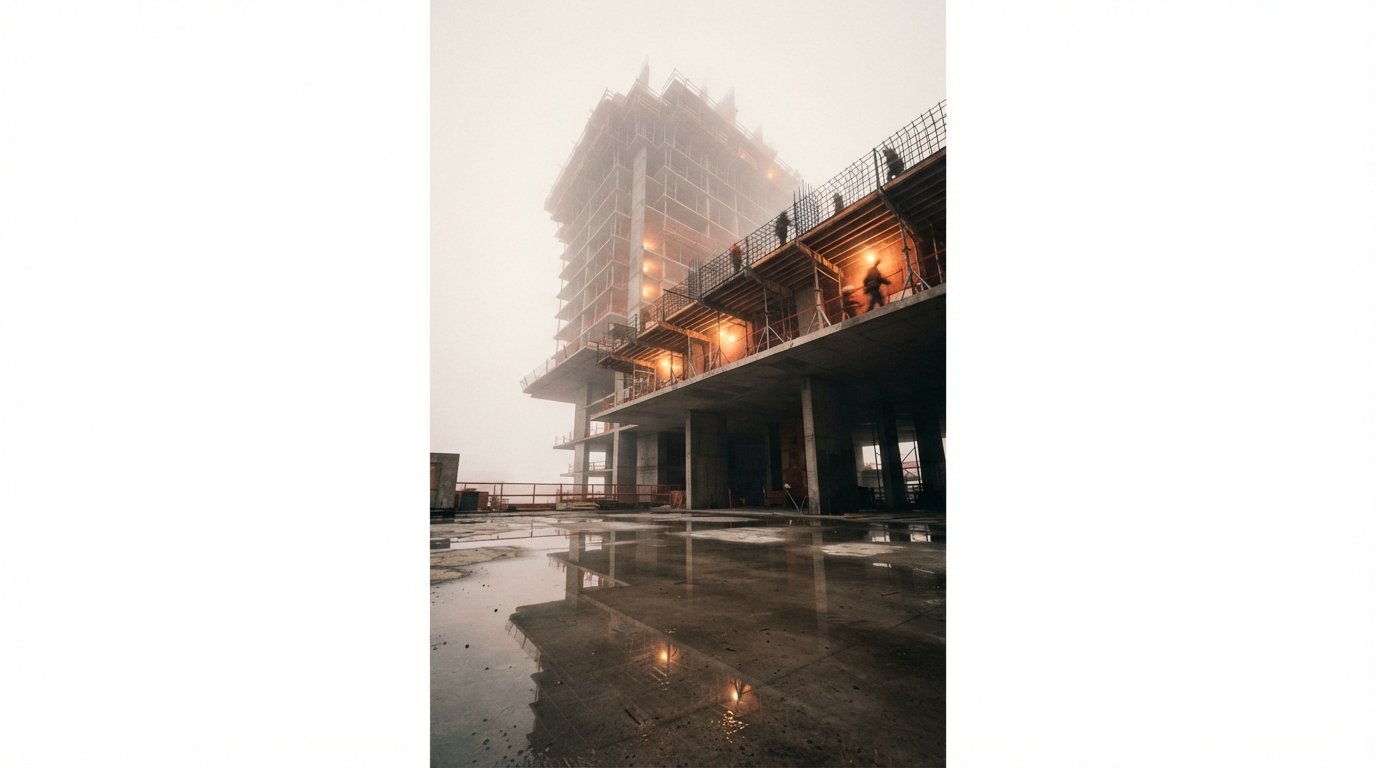
There's a particular kind of AI render that looks flawless until an architect glances at it. The light is gorgeous, the materials read as real, the composition is magazine-ready — and the egress stair lands halfway up a blank wall, the curtain wall has no discernible structure, and a five-storey brief has somehow become seven. The image is beautiful and the building is impossible. That gap, between looking right and being right, is the whole story of where architecture AI is going next.
Today's tools are, overwhelmingly, image models. They learned from photographs and renders what buildings tend to look like, and they're astonishingly good at reproducing that surface. What they have never learned is what holds a building up, what a code allows, or how a wall is actually assembled. The frontier in 2026 isn't a better-looking image. It's a model that carries some of that knowledge inside it — what the industry is starting to call domain-aware AI.

What "domain-aware" actually means
Strip away the marketing and a domain-aware system is one whose training and architecture encode the rules of the field, not just its appearance. In our world that means three layers of knowledge a generic image generator simply doesn't have.
Codes and regulation
A code-aware model treats minimum egress widths, fire separations, accessibility clearances and setback rules as constraints rather than suggestions. The promise isn't a render that happens to comply — it's a tool that can tell you when a move breaks a rule, or that won't propose a corridor narrower than code allows in the first place. The knowledge lives in the system, so it travels with every output instead of waiting for a human to catch the violation.
Construction logic
Buildings are assembled in a sequence, from materials with real tolerances, by trades with real constraints. A construction-aware model understands that a slab needs support, that a cantilever has limits, that a detail has to be buildable. This is the difference between a picture of a junction and a junction that could be drawn, specified and built.
Material properties
Beyond how a material looks, a domain-aware model carries how it behaves — weight, span, weathering, thermal performance, how it meets other materials. Adobe's long investment in materials and substance is the obvious place this knowledge enters the pipeline, turning "make it look like concrete" into "treat this as concrete, with what concrete implies."
An image model knows what a building looks like. A domain-aware model is being taught what a building is. Those are not the same product, and the second one is much harder to copy.
Why the incumbents are positioned to win this
Here's the uncomfortable part for the wave of render startups: domain knowledge is a data problem, and the incumbents own the data. Autodesk, Chaos and Adobe aren't ahead because their image quality is unbeatable — in raw aesthetics, plenty of smaller tools match them. They're ahead because they sit on the structured project information that domain awareness is built from.
Autodesk has Revit, Forma and decades of BIM models that encode real construction data. Chaos has the rendering and real-time portfolio plus deep integration into the platforms architects already model in. Adobe owns the material and texture layer the whole industry leans on. A startup can scrape millions of pretty images; it cannot easily reconstruct millions of coordinated, code-checked, fully-detailed building models. That asymmetry is why the next moat is domain understanding, and why it favours the companies that already live inside your workflow.
Autodesk — Forma and the Revit ecosystem as the path to code- and construction-aware AI, built on structured BIM data. Chaos — domain knowledge entering through integrated rendering and real-time tools that already read your model geometry. Adobe — material and substance intelligence as the layer where "looks like" becomes "behaves like." Different entry points, one direction: AI that understands the building, not just the picture of it.
Why this is bigger than geometry adherence
It's tempting to file domain awareness next to the geometry-control conversation, but they solve different problems. Model-adherence controls keep an AI faithful to geometry you've already drawn — they stop the tool from inventing a different building. Domain awareness is upstream of that: it concerns whether the tool understands what a valid building is, before you've even committed the geometry.
Adherence asks "did it draw my building?" Domain awareness asks "does it know my building has to obey gravity and code?" You can have perfect adherence to a non-compliant scheme, or a code-aware model that still needs you to lock its geometry. The two are complementary, and the most capable tools of the next eighteen months will pair them: faithful to your model and literate in the rules your model has to live by.
The honest caveats
None of this is shipping as a finished, trustworthy product yet, and architects should hold the marketing at arm's length. Three cautions matter.
Codes are local, fragmented and political. A model trained on one jurisdiction's rules is dangerous in another. "Code-aware" will mean code-aware-somewhere long before it means code-aware-everywhere, and a confident wrong answer about egress is worse than no answer at all.
Authoritative output invites over-trust. The better these tools sound, the more tempting it is to skip the check. A render that "knows the code" can lull a team into not verifying — which is exactly when the expensive miss slips through. Domain awareness should shorten your verification pass, never replace it.
The data moat cuts both ways. The same incumbent data advantage that makes this possible also concentrates it. If domain knowledge lives inside Autodesk's and Adobe's stacks, the price of leaving those ecosystems goes up. Capability and lock-in arrive together.

Our take: buy understanding, but verify it
Domain-aware AI is the most consequential shift in this field since renderers learned to read your geometry, and it will quietly redraw the competitive map: the winners won't be whoever makes the prettiest image, but whoever's model best understands the thing being imaged. For practitioners, the move is to start asking vendors a sharper question than "how good does it look?" Ask what the tool actually knows — which codes, which construction assumptions, which material behaviours — and where that knowledge stops. The tools that can answer precisely are the ones worth building a workflow around. The ones that wave at "AI that understands architecture" without specifics are still selling you a beautiful, possibly impossible, picture.
We look at what these tools know, not just what they show. Join the studio newsletter for the analysis, or read our companion pieces on agentic AI render pipelines and where Autodesk Forma's AI actually helps.
Analysis based on publicly described product directions and 2026 industry coverage. Capabilities described are emerging and vary by version and jurisdiction; confirm specifics against current vendor documentation and local code. No affiliate relationship with any tool or platform named.