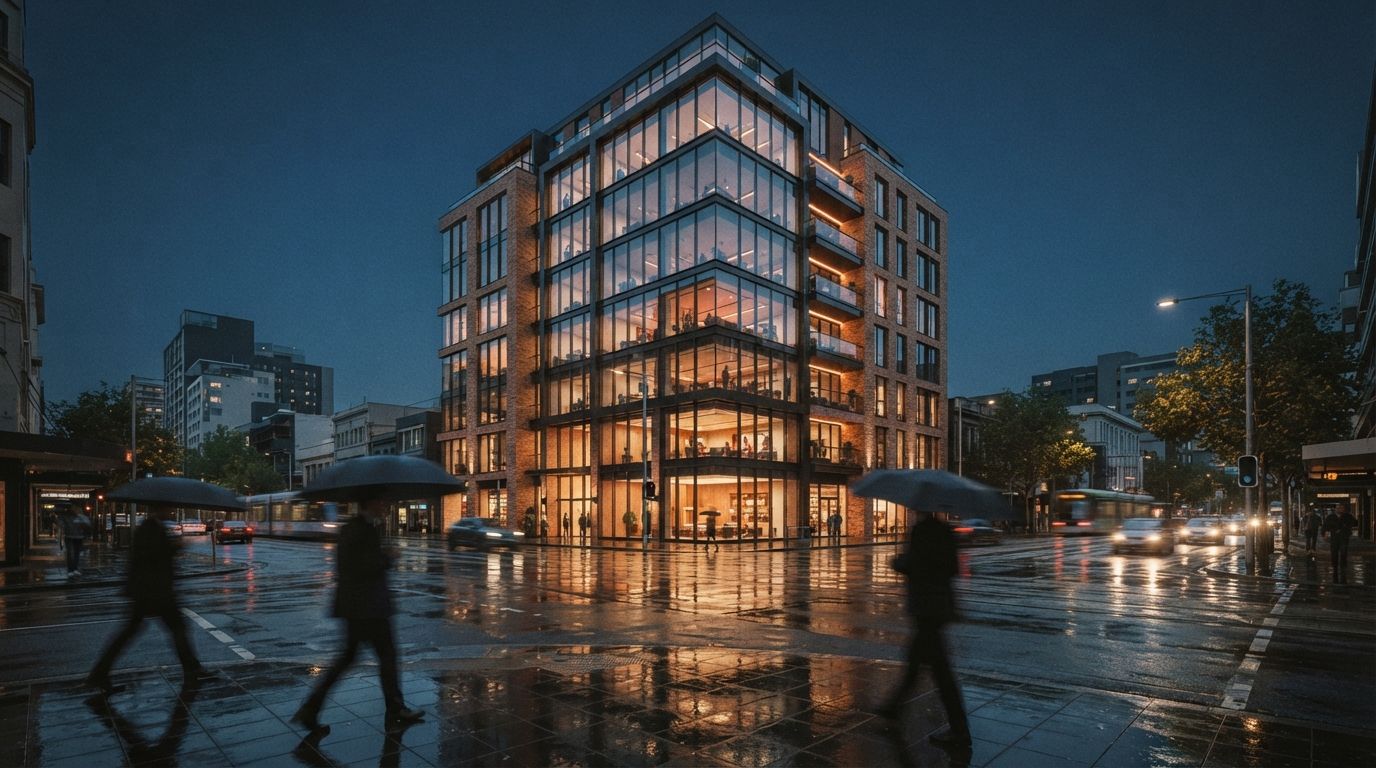
AI rendering crossed a line this year that nobody marked. It stopped being the thing you did privately to speed up a concept and started being the thing that goes straight in front of the client, in the deck, on the planning portal, on the project Instagram. This week's coverage kept circling the same point from different angles: AI visuals are now mainstream enough that clients expect that level of polish as standard. Which means the question is no longer whether to use the tools. It is whether you say so when the output leaves your screen.
Most firms have not decided. They have a clear policy on drawings and no policy at all on the generated image sitting two slides earlier in the same presentation. That is the gap worth closing, because the image is the part the client remembers and the part that can come back on you.
The question nobody puts in the contract
Start with what disclosure is actually for, because it is easy to frame this as a moral nicety and miss the practical core. A render is a promise about a building that does not exist yet. When you make that promise with a tool that fills in light, materials, planting, and reflections from a model that has never seen your site, you are signing your name to interpretation as if it were fact. The client cannot tell the difference. They read every render as a photograph of a decision already made.
So the real reason to disclose is not to confess. It is to set the status of the image. An unlabelled glossy view says "this is the building." A labelled one says "this is the direction, rendered to feel real so you can react to it." Those are different promises, and only one of them is one you can keep. The firms getting burned in 2026 are not the ones using AI. They are the ones letting an indicative image do the job of a verified one and saying nothing about which is which.
There is a second, quieter benefit. The moment you caption an image as AI-assisted and indicative, you reserve the right to change it. The corner that cannot be glazed becomes a normal design development, not a broken promise. Disclosure is the thing that keeps a render a proposal instead of a contract you did not mean to sign.
Where it stops being optional
For a concept-stage mood image, disclosure is good practice and your call. For anything a third party relies on, it moves from etiquette to exposure, and the line is sharper than most people think.
Planning and verified views. If a visual goes into a planning application as an accurate representation of how the proposal sits in its context, it is expected to be geometrically true to both the design and the existing surroundings. That is the whole point of a verified view. A diffusion pass that nudges a roofline, softens a neighbour, or invents a tree where a tree would block the objection is not a stylistic choice there, it is a false statement to an authority. Keep generative tools out of the verified set, or check every element back against the model before it goes in. We laid out the checking discipline for exactly this in the geometry hallucination QA checklist, and a planning submission is where that discipline stops being optional.
Marketing and sales. If a render sells units off-plan, the buyer is making a purchase against the image. Advertising rules in most markets already treat a materially misleading visual as a problem regardless of how it was made. AI does not create a new rule here, it just makes it far easier to break the old one by accident, because the tools are so good at producing a beautiful lie.
Confidentiality runs alongside this. Disclosure is about the output. The input has its own duty, because feeding a client's unbuilt scheme into a cloud model is its own decision with its own risk, which we worked through in the piece on cloud rendering and client confidentiality. The two questions are separate and you need an answer to both.
What honest disclosure actually looks like
The fear is that a label cheapens the image, that "AI-generated" in the corner makes the client trust it less and you with it. In practice the opposite holds, as long as the disclosure is specific rather than a nervous disclaimer. Vague hedging reads as covering yourself. A precise caption reads as control.
The useful move is to separate the image into what is accurate and what is interpretation, the same way you already distinguish a survey drawing from a sketch. The geometry, if it came from your model, is real. The light, the materials, the people, the planting, the weather, those are interpretation, generated to make the proposal legible. Say that. A client has never lost confidence in a hand-drawn perspective because it was clearly a drawing. They lose confidence when a photographic image turns out to have quietly promised a finish, a daylight level, or a corner the building cannot deliver.
| Image type | Disclose? | How to caption it |
|---|---|---|
| Early concept mood image | Optional, recommended | "Indicative AI-assisted visual, concept stage. Not a depiction of final design." |
| Client-facing scheme render | Yes | "Geometry from model. Light, materials and context are indicative and AI-assisted." |
| Off-plan sales / marketing | Yes, prominently | "Computer-generated indicative image. Finishes and surroundings subject to change." |
| Planning verified view | No AI unless fully checked | Verified to model and survey. Generative edits removed or individually validated. |
Notice that the highest-stakes row is the one where the answer is not "disclose harder" but "do not use the tool that way." Disclosure handles ambiguity. It does not launder a view that has to be true and is not. For that, the only fix is geometry you can stand behind.

A policy you can run on Monday
You do not need a committee for this. You need three sentences in your image standards and the discipline to apply them. First, every AI-assisted image that leaves the studio carries a caption stating that it is AI-assisted and indicative, and naming what is accurate. Second, nothing generative enters a verified or contractually-relied-upon view without being checked element by element against the model. Third, the same note that sets client expectations also protects your right to develop the design, so write it as a status, not an apology.
Set that once and the awkward conversation disappears, because there is no awkward moment left to have. The client knew from the first slide that the picture was a tool for thinking, not a photograph of a finished thing. That framing is also what keeps AI a help rather than a liability as client expectations climb, a shift we tracked in how mainstream AI rendering reset what clients expect.
Our take: label the promise, not the tool
The instinct to hide that a render is AI comes from treating disclosure as an admission of weakness, as if the client wanted a photograph and you handed them a generated approximation. That gets the relationship backwards. The client does not want a photograph of a building that does not exist. They want to understand what they are agreeing to. A render's job is to make a proposal legible and reactable, and a label that says exactly what is fixed and what is still open does that job better than a slick image pretending to be final.
Disclosure is not confessing the picture is AI. It is telling the client which parts of it are a promise.
So put the line in. Not because a regulator is making you yet, though in the verified-view world they effectively already are, but because the alternative is a beautiful image doing the work of a contract you never read. Say what is real, say what is interpretation, and let the render be what it is good at: a fast, honest way to show someone a building before it is built. The firms that get this right will not be the ones who used AI quietly. They will be the ones who were never embarrassed to say they did.
Drawn from this week's intel sweep of 2026 architectural visualization coverage, where AI rendering was repeatedly described as mainstream and now expected by clients as standard, with generated visuals reaching presentations and submissions that were once the territory of verified photography. ArchiGen AI runs no sponsored placements and has no affiliate relationship with any rendering vendor.